

Tough Ain't Enough
Language as a Rehab Environment

In Million Dollar Baby, Frankie Dunn (Clint Eastwood) looks at Maggie Fitzgerald (Hilary Swank) and drops a line that lands like a glove to the ribs: “Girlie, tough ain’t enough.”
I grew up with another sentence; less cinematic, more ambient. The kind that doesn’t arrive as dialogue, but as weather: real men don’t cry.
Same ecosystem. Same idol. Different phrasing.
Then rehab happened.
Not as an inspiring montage. Not as a clean upward graph. But as a daily negotiation between bone and fear, between effort and swelling, between what I wanted to prove and what my body was actually saying. And somewhere inside that negotiation, something turned in me permanently.
Rehab isn’t only physical. It’s also linguistic.
The words around recovery, spoken by clinicians, family, and the quiet voice inside your own skull, don’t just describe what’s happening. They shape what you attempt, what you admit, and what you hide. They shape what your nervous system believes is safe. And in rehab, what feels safe is what becomes possible.
The sentence that changed my gait
There’s a question that arrives in rehab with the casual tone of routine: “How’s your pain from zero to ten?” It sounds like a neutral tool. A simple scale. A clean metric.
Except it isn’t neutral for everyone.
Because sometimes that number stops being data and becomes a status token; a way of signaling: I’m strong. I’m easy. I’m not a burden.
I’ve done it. I woke up after a session with pain spiking hard, pain that sharpened my breath and made my body move like it was walking through glass. And when asked, I gave the room a cleaner story.
“Two or three,” I said. A small smile. A little bravado. A little lie. Not because I wanted to deceive anyone, but because I wanted to stay loyal to a role. Because I wanted to remain me: the one who doesn’t complain, the one who can take it, the one who doesn’t need help.
The problem is: the body hears the lie.
It makes sense that it does. The brain is built for fast sorting: safe and unsafe, help and harm, strong and weak. It’s a survival machine. And when you’ve been trained in toughness, that sorting turns moral. “Two or three” doesn’t just report pain. It protects an identity.
But rehab isn’t a predator you can outrun. It’s a budget you have to manage.
Healing doesn’t reward the cleanest category. It rewards the best revision: adjust the dose, tell the truth, use support, learn the body’s language before it has to shout. Because the body doesn’t politely disagree. It tightens. It braces. It compensates without telling you. It starts building a workaround, and then you end up injured in a new place you didn’t come in to treat.
Underreporting pain isn’t toughness. It’s a language-game. The moment the number becomes reputation, the body’s evidence leaves the room. And it costs. Not only in swelling or sleep, but in learning. Because once you start protecting a role, you stop running experiments. You stop gathering clean data. You stop adjusting the dose. You start playing the game that gets you praised.
And rehab, quietly, becomes a place where words are not descriptions. They’re moves.
Rehab has games. Words are moves.
Wittgenstein gives me a useful lens here. Words don’t get their meaning from a definition. They get their meaning from their use, from what they do inside a shared practice. He called those practices language-games, not because language is trivial, but because language has rules. Unwritten rules. Rules you absorb without noticing.
Those rules belong to a form of life: the kind of world a group is living inside—the norms it rewards, the fears it avoids, the virtues it praises.
Think of a kitchen in the middle of dinner rush. “Yes, Chef” isn’t a personality trait, it’s the language of speed, hierarchy, and coordination. In that world, hesitation is costly, and clarity is care. Of think of a courtroom. “Objection” isn’t an emotion, it’s a sanctioned move inside a ritual where truth has to pass through procedure, and a single word can stop time.
Rehab has its own language-games. Rooms you walk into without realizing you’ve accepted the rules.
Sometimes the dominant game is safety, and the air is thick with warning. Someone says “Don’t fall” the way you’d say “Don’t die,” and without anyone touching you, your shoulders rise. Your steps shrink. You start moving like the floor is guilty until proven innocent. In that climate, caution stops being information and becomes a mood, and the mood moves straight into your muscles.
Sometimes the game is compliance, and the price of belonging is smoothness. You nod before you understand. You don’t want to be “difficult.” You want to be a good patient. So you edit the messy truth. You offer clarity when what you really have is confusion. You offer calm when what you really have is fear. You shrink your story to fit what feels acceptable to say.
Sometimes the game is performance, and the room becomes a quiet stage. The rail becomes an audience. The therapist’s glance becomes a scoreboard. You push one rep past clean form, not because the rep is wise, but because the rep proves something: that you still belong to the old version of yourself.
And sometimes the game is learning, and suddenly everything changes without changing at all. Same exercises. Same hallway. Same stairs. But pain is no longer a verdict; it’s a signal. You test, you log, you adjust. You leave with more trust than pride.
Here’s the hinge: the same sentence can be care in one game and control in another. Meaning isn’t what the sentence says. Meaning is the move it makes.
“Let’s try one more rep” can feel like a hand at your back when you’re learning, and like a sentence being handed down when you’re performing. “Be careful” can be useful when it comes with a concrete instruction, and paralyzing when it arrives as a vague alarm. Meaning is in the move. And the move lands in the body.
The toughness game
The toughness game is not just inside you. It’s a whole moral weather system. It has a vocabulary, and it has rewards. Stoicism. Silence. Doing it alone. “I’m fine.” And it has punishments too: tears, hesitation, needing a rail or a cane or a pause or a hand, telling the truth of your limits.
In some cultures it’s explicit: real men don’t cry. In others it’s implied: the raised eyebrow, the praise for pushing, the subtle shame around devices. Either way, the game trains you to convert pain into performance.
And rehab is where that training turns toxic, because rehab is not a stage. It’s a lab.
If you treat it like a stage, you stop learning. And when you stop learning, you stop recovering.
The stairs as a stage
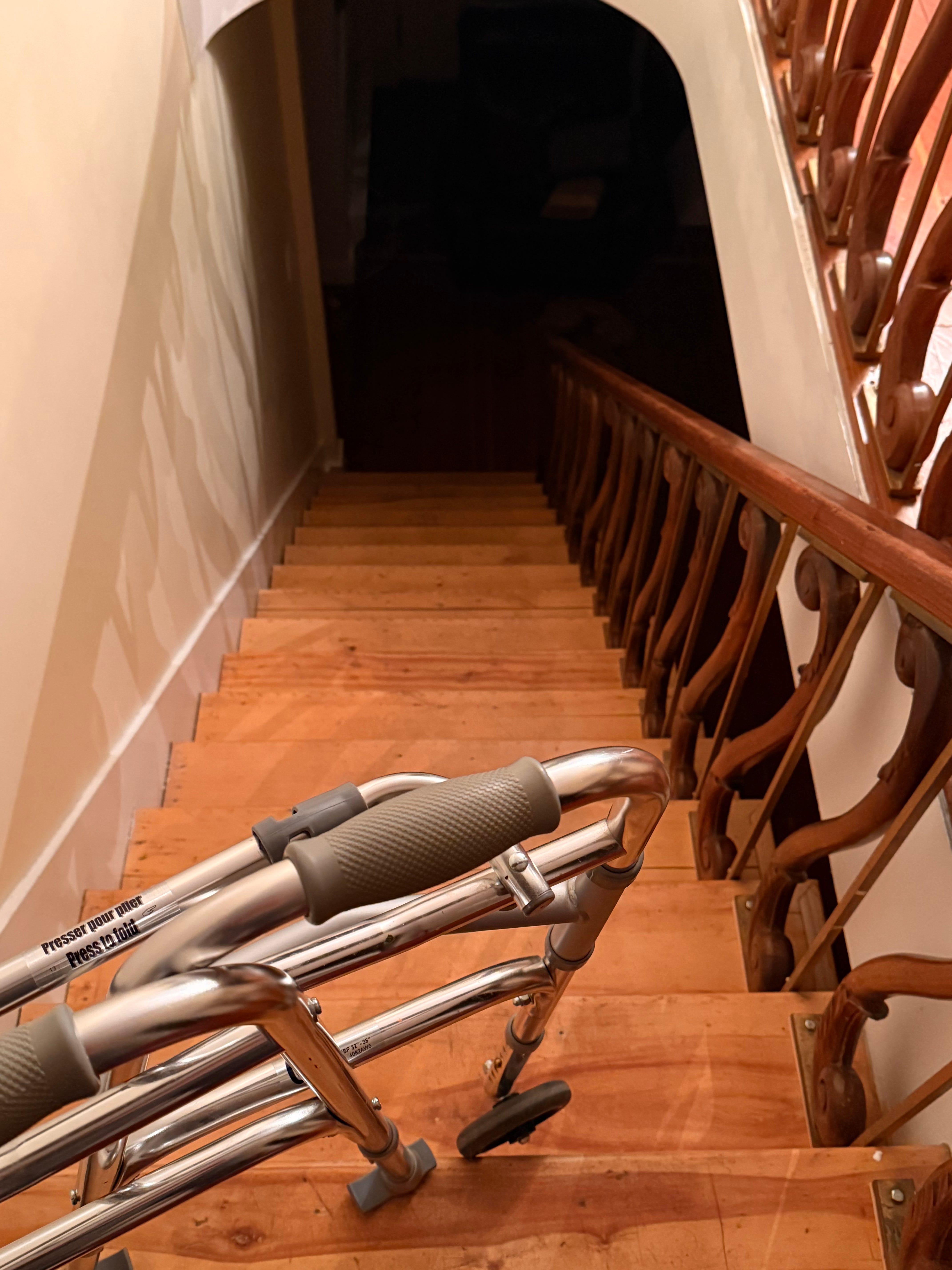
The stairs are never just stairs. They become a trial. A small audition for the role of “independent.” A chance to prove you’re still the person you were before the fracture, before the cane, before the slowness, before the new contract.
Week two post-surgery. The goal is modest: 17 flights of stairs with a rail, one step at a time. But the voice in the head, the ancient coach, doesn’t speak modestly. You’ve got this. Don’t be weak. Don’t rely on the rail. Real men don’t need railings.
So you take one flight, fine. Then another, still fine. Then another, because “fine” has become fuel.
By evening the body answers in its own language: swelling, heat, a pain flare that steals sleep and confidence. And the next day, you’re not sure whether to confess what happened. Because confession feels like losing.
That’s the trap.
When rehab becomes performance, you stop learning. When you stop learning, you stop recovering. Toughness doesn’t listen. It performs.
That’s how a staircase turns into propaganda: repetition that feels like virtue. And the cruel part is how familiar it feels. Because the toughness game once kept something intact: reputation, identity, belonging, the right to be admired. It’s not stupid. It’s old.
But rehab exposes the trade. The more you protect the role, the more you injure the body that has to play it. So the question shifts. Not “How do I prove I’m still me?” but: what kind of me can live inside this body now, without lying to it?
That’s where dignity shows up. Not as pride. As a technique.
The dignity hinge: from independence to authorship
This is where I want to connect back to Towards an Ethics of Help and Dignity in Dependence. Because what rehab threatens isn’t only mobility. It’s identity. It tempts you to treat every device, every pause, every hand offered as evidence in a trial: dependent, diminished, failing.
But autonomy was never “doing everything yourself.”
Autonomy is directing a life. Choosing the tools, the supports, the pace, the relationships that let you live on your terms. In rehab, dignity is a linguistic hinge. One small pivot changes the whole room. If I need help, I’ve failed, becomes if I use help well, I’m skilled. The cane stops being a confession and becomes a training strategy. Rest stops being weakness and becomes part of training.
This isn’t self-esteem talk. It’s engineering. Because the body doesn’t heal on ideology. It heals in an environment where signals can be told truthfully, and heard without shame.
What counts as progress?
Here’s a quiet question that changes everything: what counts as progress here?
Every practice has criteria or shared signs that decide what counts as real. In rehab, the criteria aren’t just medical. They’re cultural, moral, often invisible. In many settings, progress gets reduced to narrow metrics: degrees, steps, distance, speed. These numbers matter, but they don’t capture the whole recovery.
Progress can also be sleeping through the night for the first time in weeks. It can be noticing less bracing in the shoulders. It can be a smoother weight shift. It can be less dread before leaving for physio. It can be enough safety to tell the truth about pain. It can be a week without boom-and-bust heroics.
If the only things that count are visible feats, the toughness game will always win because it can produce feats even when the foundation is cracking. A humane rehab language enlarges the scorecard, not to be soft, but to be accurate.
Two rehab worlds: the courtroom and the lab
I’ve felt two different rehab climates in my body.
In the courtroom, everything becomes a verdict, sometimes out loud, sometimes just in the air. You can feel it in the categories: compliant or noncompliant, good patient or difficult patient, progress or setback, strong or weak. In the courtroom, people edit. They round down the pain. They hide the fear. They do the rep with sloppy form and call it “fine,” because nobody wants to be found guilty of weakness. And once rehab becomes moral, the nervous system does what it always does under judgment: it braces, performs, conceals.
In the lab, nothing is a verdict. Everything is information you can work with. “I failed” becomes “that dose was too high.” “I’m regressing” becomes “pain rose twenty-four hours later and sleep dropped.” “I’m being difficult” becomes “something is making this hard, let’s find out what.” In the lab, you don’t win or lose. You learn.
Learning isn’t a vibe. It’s protection. It prevents avoidable harm. It builds trust. It keeps the loop honest. Rehab improves when we shift from moral language to informational language. This shift is not cosmetic. It changes what people report, what clinicians can treat, what the body dares to attempt.
A rehab language protocol you can actually use
I don’t want this to remain theory. I want it to be usable, something like a pocket card you could carry into a session.
The first rule is to speak in footage. Describe what a camera would record. Instead of “setback,” you say, “stairs twice yesterday; pain spiked at night; swelling up today.” Instead of “bad day,” you say, “slept four hours; limping started after noon; needed two breaks.” Footage has no shame. Footage can be used.
The second rule is to retire vague alarms unless they come with an action. “Be careful” is not guidance; it’s fog. If someone says “be careful on the stairs,” the next sentence should be operational: “use the rail, one step at a time, slow enough you could stop mid-step.” If someone says “don’t overdo it,” the translation should be concrete: “stop while form is still clean.” Vague warning creates fear. Operational guidance creates competence.
The third rule is to replace obedience with problem-solving. The moral labels that end conversation: noncompliant, unmotivated, difficult, are often just ways of not looking closely. In a lab, “noncompliant” becomes “a barrier showed up, pain flare, fatigue, transport, confusion, fear; which one?” “Not motivated” becomes “what makes this hard to start?” The goal is not compliance. The goal is a plan that survives a real life.
The fourth rule is to treat help as technique. Supports are not failure. They are strategy. “Don’t get dependent on the cane” becomes “use it to practice clean gait and confidence so you can go farther.” “If you rest, you rust” becomes “rest is part of training.” Help isn’t the opposite of autonomy. Help is often the condition for autonomy.
In rehab, language is equipment.
Use what protects healing.
Discard what performs toughness.
A daily practice: the language-game check
There’s a small practice I return to when a phrase shows up, whether spoken by someone else, or by my inner coach. I run it through three fast questions. What is this trying to get me to do: perform or learn? What does it do to my body right now: tighten or settle? And what’s the next instruction, exactly, one action I can test?
Then I rewrite on the spot.
No pain, no gain becomes: pain is a signal, find the dose I can repeat tomorrow.
Suck it up becomes: name it, scale it, adjust it.
A small rewrite can change the entire room. Including the room inside you.
Closing: the kind of strength rehab actually needs
So yes, Frankie Dunn was right. Tough ain’t enough.
Not because we should be fragile. But because recovery isn’t a contest. It’s not a morality play. It’s not a proof of character. Recovery is a relationship with reality.
And reality demands a different kind of strength: the strength to be accurate, the strength to report what’s true, the strength to pace without shame, the strength to use support without apologizing.
Here’s the creed I’m trying to live now: strength is accuracy; precision is care.
And the body, when it finally trusts the language around it, does something remarkable. It stops bracing for judgment. It starts learning again.
That’s when rehab becomes what it was supposed to be from the beginning.
Not punishment.
Not performance.
A way back into life, word by word, step by step.